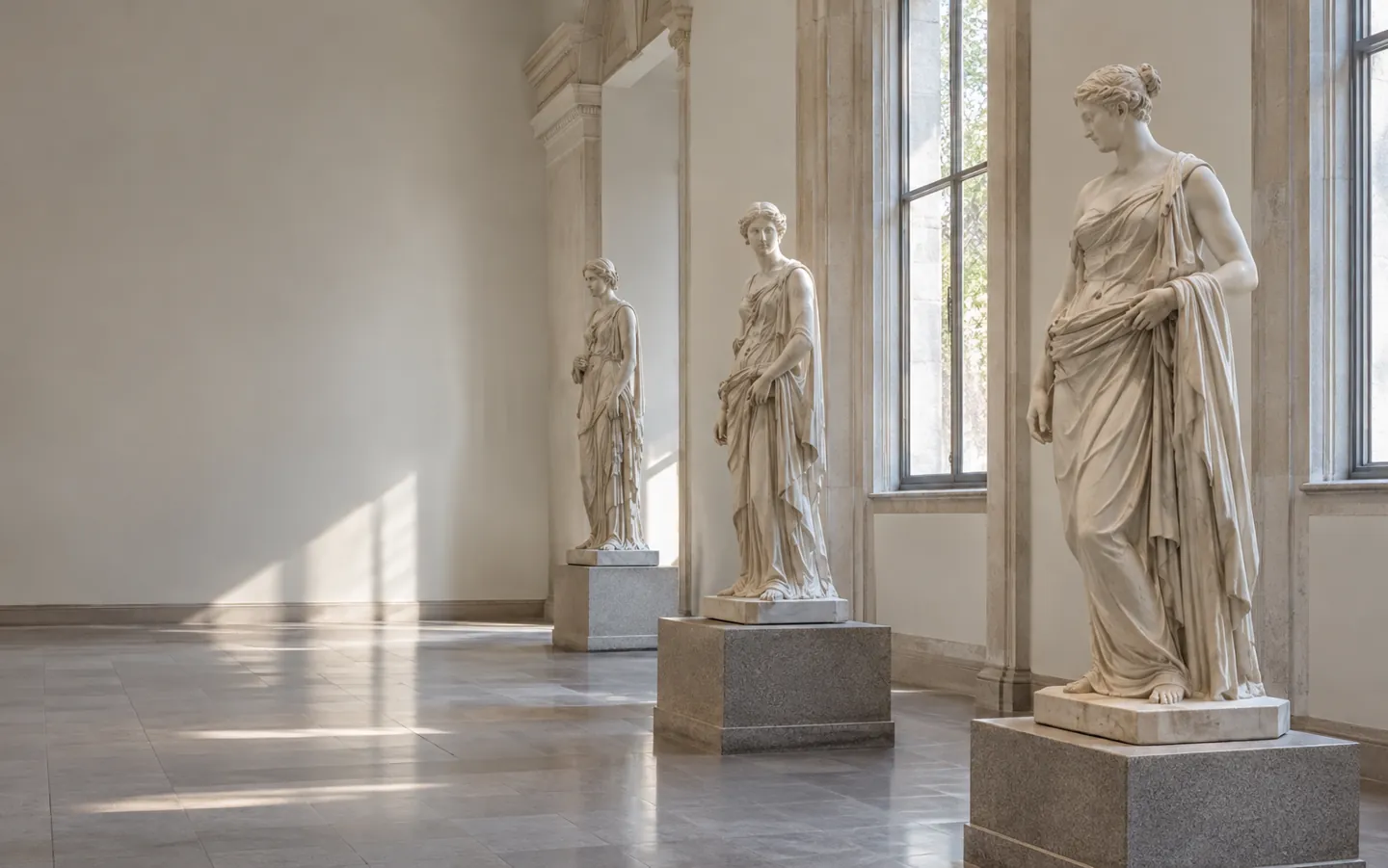
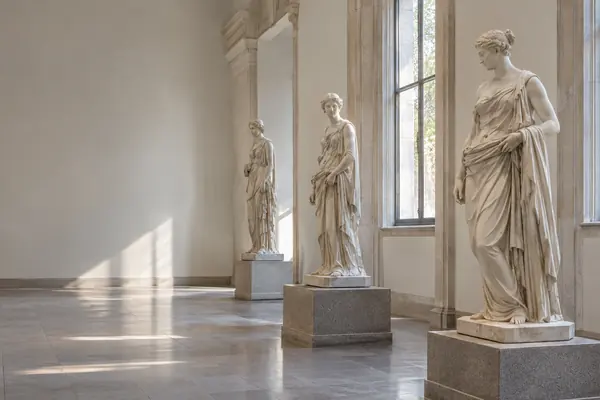
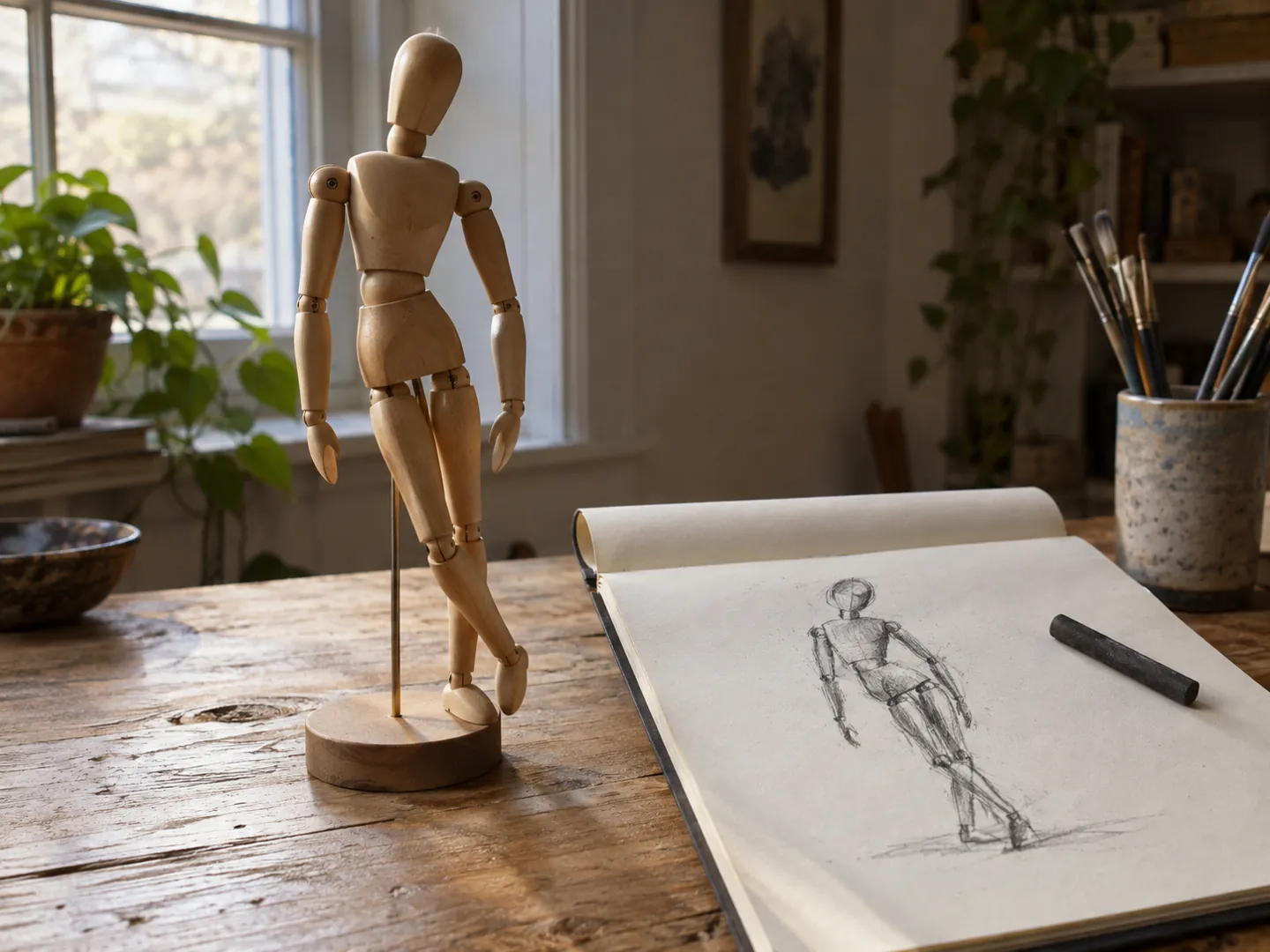
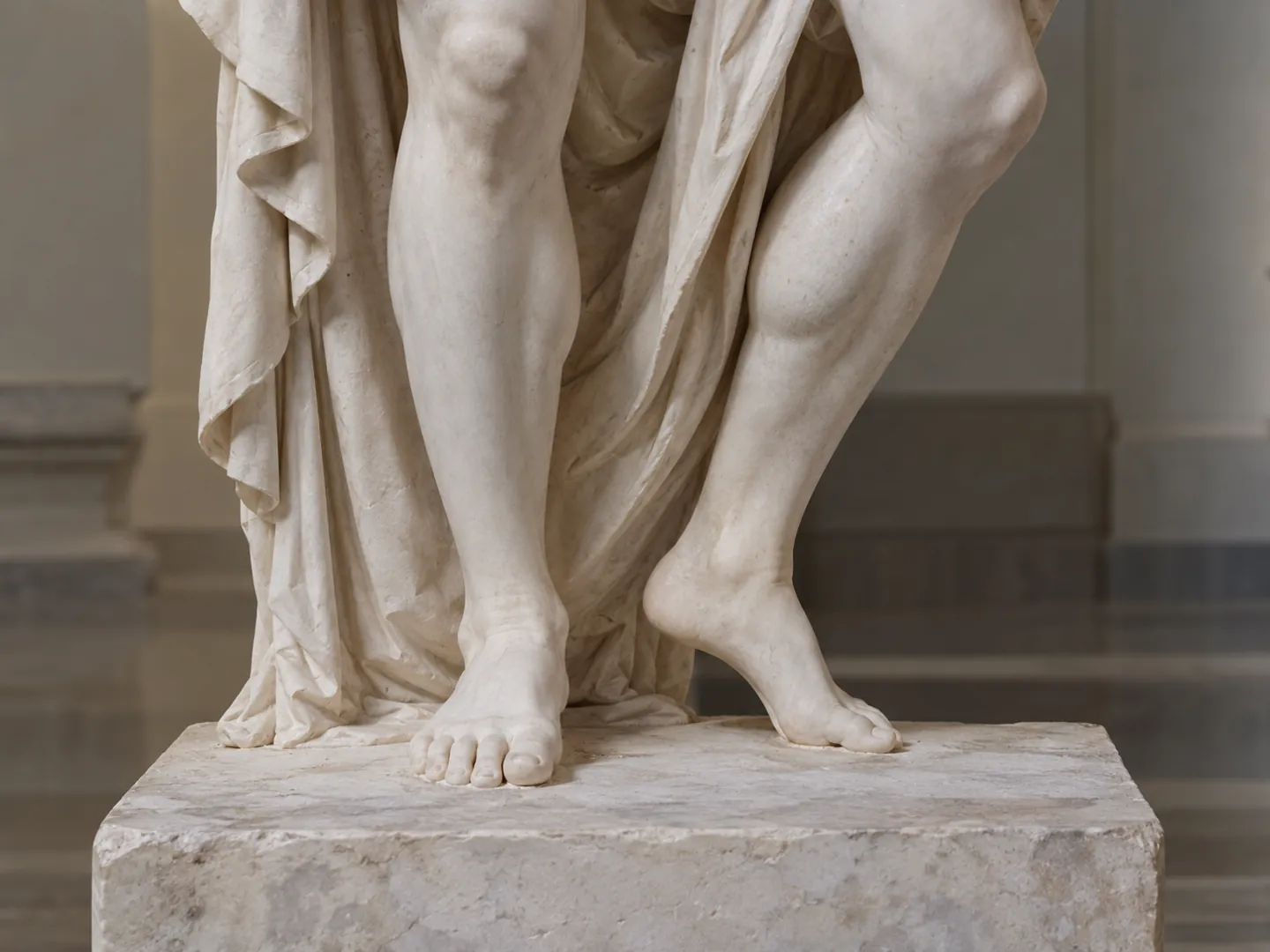
Early Greek statues stood rigid and symmetrical. In the early 5th century BC sculptors began resting the weight on one leg, and the hips, shoulders and head followed. Renaissance sculptors later gave it the name contrapposto.
AI-generated image, not a photograph of a real person or place.
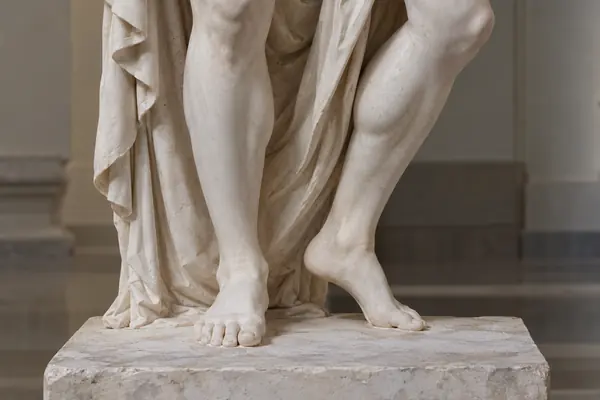
Find the engaged leg
Watch the hips tilt
Let the shoulders answer
A pose that looks alive
THE SHORT ANSWER
Weight on one leg, movement everywhere.
Contrapposto is a small change with a big effect. Three ideas explain it.
BEFORE
The rigid kouros
The Met describes an early Greek kouros standing rigidly, left leg forward, arms at its sides, a pose derived from Egyptian art and a standard formula through the 6th century BC.
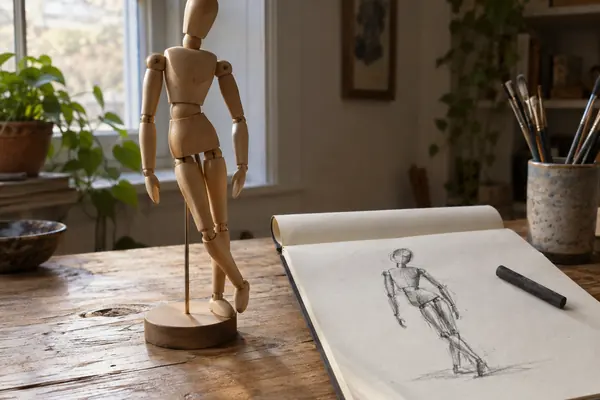
With the weight shift, Britannica says, the hips, shoulders and head tilt, suggesting relaxation and subtle movement. The same checks help when you draw a standing figure.
Pick what you notice about a standing statue. The bar shows how far the pose has moved from the stiff, even stance towards full contrapposto.
Based on Encyclopaedia Britannica, Smarthistory and The Metropolitan Museum of Art.
TWO STATUES, TWO STAGES
From stiff stride to easy stance.
A rigid early kouros in New York, a relaxed youth in Athens.
194.6 cm
Height of an early Attic kouros
The Met calls this kouros one of the earliest marble statues of a human figure carved in Attica. It stands rigidly, left leg forward, and marked the grave of a young Athenian.
THE MET · KOUROS, c. 590–580 BC
1.22 m
Height of the Kritios Boy, after 480 BC
The Acropolis Museum says the Kritios Boy, in marble from Paros, rests its weight on the left leg while the right is loose and bent at the knee. Smarthistory dates it roughly 480 to 470 BC.
ACROPOLIS MUSEUM · KRITIOS BOY
The Kritios Boy was found in two pieces: the torso in 1865 to 1866 south-east of the Parthenon, and the head in 1888 near the south walls of the Acropolis.
FOUR THINGS TO LOOK FOR
Read the pose from the ground up.
The same checks work on a statue in a gallery, a photo of a friend or a figure you are drawing.
Find the engaged leg
Look for the straight leg carrying the weight. The other is relaxed and bent at the knee.
Check the hips
In the Kritios Boy the weight sits on the left leg and the right hip is lower than the left.
Check the shoulders
The shoulders tilt the other way: in the Kritios Boy, the left shoulder sits lower than the right.
Notice the head
A slight turn of the head, Smarthistory says, makes the Kritios Boy look more alert.
AI-generated image, not a photograph of a real person or place.AI-generated image, not a photograph of a real person or place.
WHY IT MATTERS
A body that moves as one.
Smarthistory explains that in the Kritios Boy the body works as a unit: a shift in one part affects the rest. That is what makes the figure look as if it might step forward.
Britannica says the Greeks invented the formula in the early 5th century BC as an alternative to the stiff, evenly weighted stance of earlier figures, and Renaissance sculptors revived it centuries later.
Questions
Questions people ask
What does contrapposto mean?
Britannica describes it as a scheme in which a standing figure rests its weight on one leg, the engaged leg, freeing the other leg, which is bent at the knee. The hips, shoulders and head tilt with the shift.
When was contrapposto invented?
Britannica says the Greeks invented the formula in the early 5th century BC. The Kritios Boy, dated after 480 BC by the Acropolis Museum, is a well-known early example.
What came before contrapposto?
The kouros. The Met describes an early example standing rigidly with the left leg forward and arms at its sides, a pose derived from Egyptian art.
Who named the pose contrapposto?
Britannica says Renaissance sculptors revived the classical formula and gave it the name contrapposto.
How tall is the Kritios Boy?
The Acropolis Museum gives its height as 1.22 m. Smarthistory notes the statue is under life size.